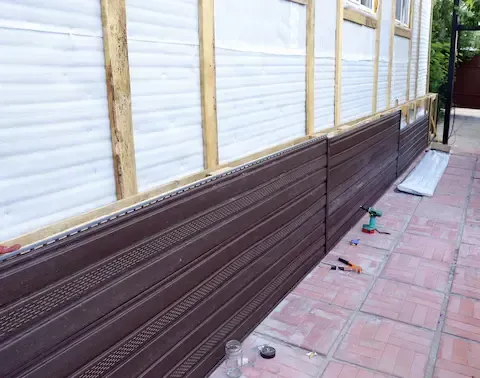
How Long Does Commercial Siding Last in Minneapolis MN?
Commercial siding in Minneapolis typically lasts between 20 and 50 years depending on the material chosen and the quality of installation. LP SmartSide engineered wood siding commonly lasts 25 to 30 years in Minnesota's climate. Metal panel systems can reach 40 to 50 years with proper maintenance. Fiber cement siding falls in the 30 to 40 year range. Minneapolis winters, freeze-thaw cycles, and UV exposure all accelerate wear, so material selection and professional installation are critical factors in how long your commercial siding actually performs.
How Long Does LP SmartSide Last on Commercial Buildings in Minneapolis?
LP SmartSide engineered wood siding typically lasts 25 to 30 years on commercial buildings in the Minneapolis area. The product is treated to resist moisture, fungal decay, and impact damage, which makes it well-suited for Minnesota's demanding climate. However, its lifespan depends heavily on maintaining the finish coat. In the Twin Cities region, where temperatures swing from below zero in January to high humidity in July, the surface coating takes significant stress. Repainting or refinishing every 7 to 10 years extends the panel life considerably. Improper installation — particularly at seams, corners, and around openings — allows moisture infiltration that shortens lifespan by years.
How Long Do Metal Panel Systems Last on Commercial Exteriors?
Metal panel siding systems, including steel and aluminum cladding, are among the longest-lasting options available for commercial buildings in Minneapolis. When properly installed and maintained, metal panels routinely last 40 to 50 years. Galvanized steel and Kynar-coated aluminum panels resist corrosion well, even under the road salt exposure common along commercial corridors in Minneapolis. The primary maintenance requirement is periodic inspection of fasteners and sealants, both of which can degrade faster than the panels themselves. Scratch-through rust on steel panels is the most common failure point and should be addressed promptly to prevent accelerated corrosion in freeze-thaw conditions.
How Long Does Fiber Cement Siding Last in Minnesota's Climate?
Fiber cement siding on commercial buildings in Minneapolis generally lasts 30 to 40 years. It resists rot, insects, and fire, and it holds paint well compared to wood-based products. The material does not expand and contract as dramatically as engineered wood under temperature swings, which is a meaningful advantage in a climate that regularly sees a 100-degree annual temperature range. However, fiber cement is moisture-sensitive at cut edges. In Minneapolis installations, proper sealing at all cut ends and penetrations is essential to prevent water absorption that can cause cracking over freeze-thaw cycles. Buildings near Lake Minnetonka or other water features may see slightly accelerated weathering from humidity and moisture exposure.
What Factors Reduce Commercial Siding Lifespan in Minneapolis?
Several conditions specific to the Minneapolis area shorten commercial siding lifespan faster than national averages suggest:
- Freeze-thaw cycling: Minneapolis averages over 50 freeze-thaw cycles per year. Any moisture that penetrates the siding system expands when frozen, widening gaps and causing surface cracking.
- UV exposure: Minnesota summers bring intense sun that degrades surface coatings, particularly on south- and west-facing elevations.
- Ice dam effects: On commercial buildings with low-slope roofs or wide overhangs, ice damming can force water behind siding at the roofline.
- Deicing salt spray: Commercial properties along high-traffic roads in Minneapolis are exposed to salt-laden vehicle spray that accelerates corrosion on metal panels and degrades caulk and sealants faster.
- Poor initial installation: Gaps at flashings, missed vapor barrier laps, or improper fastener patterns create entry points for moisture that reduce panel life by 5 to 15 years regardless of material quality.
If you are evaluating options for a new build or re-cladding project, reviewing Minneapolis commercial siding options gives you a practical comparison of how different materials perform under local conditions.
How Does Installation Quality Affect Commercial Siding Lifespan?
Installation quality has as much impact on lifespan as material selection. A high-quality fiber cement product installed with insufficient attention to flashing and sealing will fail earlier than a mid-grade metal panel system installed correctly. In Minneapolis commercial construction, the critical installation details include proper weather-resistive barrier lapping, correct fastener type and spacing for the material, sealed penetrations at mechanical, electrical, and signage openings, and expansion gap management for materials that move with temperature change. Choosing an experienced contractor familiar with Minnesota building code requirements and local climate conditions is the single most effective way to ensure your siding reaches or exceeds its rated lifespan. Professional siding installation from a contractor with local commercial experience protects the full investment in your exterior cladding system.
When Should You Replace Commercial Siding in Minneapolis Instead of Repairing It?
Repair makes sense when damage is localized to a section of the facade and the surrounding material is structurally sound and within the first half of its expected lifespan. Replacement becomes the better financial decision when more than 25 to 30 percent of the cladding surface shows signs of failure, when moisture damage has reached the sheathing or framing behind the panels, or when the building is approaching a major renovation cycle anyway. In Minneapolis, buildings that have reached 25 or more years on original siding are often better served by full re-cladding than ongoing patch repairs, particularly if the original installation predates modern moisture management standards.
